
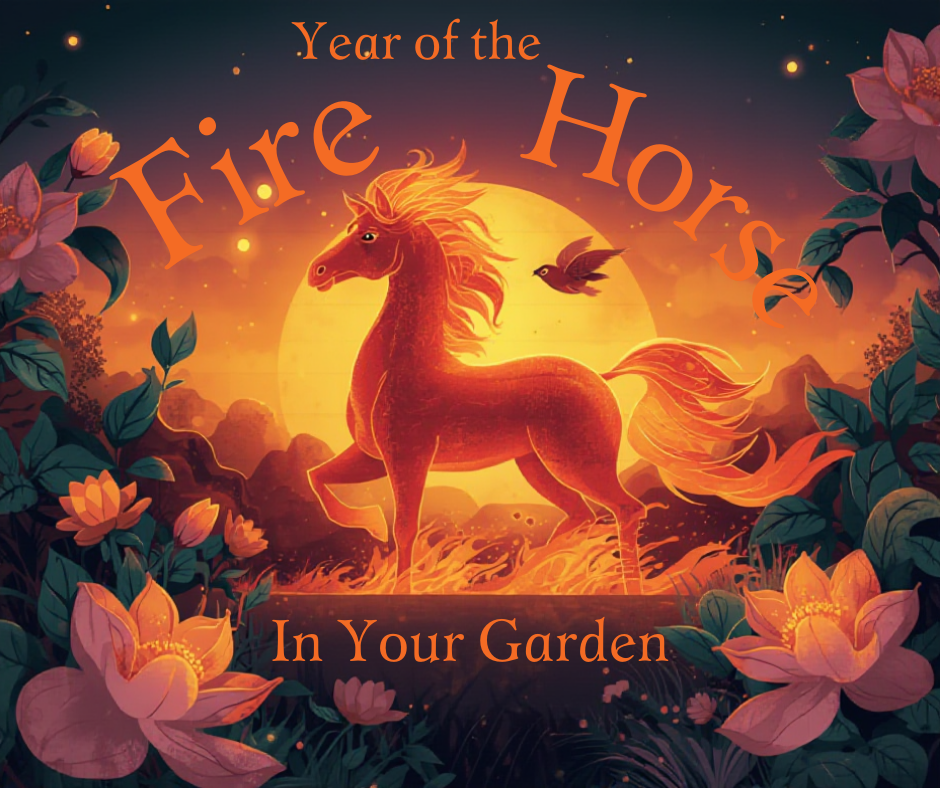
In Chinese astrology, 2026 welcomes the Year of the Fire Horse. The Horse brings energy, movement, and independence; the Fire element adds passion, transformation, and boldness. Learn what the Fire Horse symbolizes in the garden and how to use its energy to make garden design and plant choices.
What the Fire Horse symbolizes for your garden
Energy and motion: The Horse is associated with speed, travel, and activity. Gardens that emphasize movement—meandering paths, flowing grasses, cascading water features—capture this quality.
Passion and transformation: Fire encourages bright color, dramatic contrasts, and renewal. The Fire Horse favors bold decisions: replacing overgrown areas, creating a new focal point, or trying a new gardening style.
Independence and boldness: The Horse’s independent spirit supports risk-taking. This is a good time to experiment with unusual plant pairings, drought-tolerant choices that challenge conventional lawns, or installing a striking specimen tree or sculpture.
Design ideas keyed to the Fire Horse
Create a bold focal point: A specimen tree with an eye-catching silhouette (e.g., Japanese maple with red foliage, red-twig dogwood, or a flowering cherry) serves as the garden’s “stallion.” Place it where movement—paths, sightlines, or gathering spots—naturally leads.
Emphasize movement: Use ornamental grasses, arching perennials, and layered plantings to produce visual flow. Paths of decomposed granite, flagstone, or stepping stones encourage motion through the landscape.
Contrasting color and texture: Fire Horse energy favors strong contrasts. Combine warm-hued flowers (salvias, gaura, penstemon, red hot poker) with silvery foliage (lavender, artemisia, lamb’s ear) for dramatic effect.
Water and flame motifs: A small water feature—bubbling urn, narrow rill—adds movement and life. Accent lighting or a fire bowl on the patio introduces literal and symbolic fire elements that heighten the garden’s dynamism.
Layered outdoor rooms: Create independent zones within the garden—a lively entertaining area, a quiet reading nook, a wild pollinator patch—reflecting the Horse’s free spirit and the Fire element’s transformational potential.
Plant selections that reflect Fire Horse energy
Choose plants with vivid color, dynamic form, and resilience. Consider native and drought-tolerant options that thrive in our Bay Area climate while making a strong visual statement.
Structural trees and shrubs:
Acer palmatum (Japanese maple) — for dramatic foliage color and form
Arbutus 'Marina' (strawberry tree) — evergreen, ornamental bark, and flowers
Cercis occidentalis (western redbud) — early pink blooms and sculptural branches
Quercus agrifolia (coast live oak) — long-lived native anchor specimen
Bold-flowering perennials and shrubs:
Salvia spp. — spikes of red, purple, or blue attract pollinators
Penstemon spp. — tubular flowers in bold shades
Arctostaphylos (Manzanita) — pink urn flowers, evergreen foliage, drought-tolerant native
Ceanothus (wild lilac) — vivid blue flowers, native shrub with strong seasonal presence
Ornamental grasses and movement-makers:
Muhlenbergia rigens (deergrass) — plumes and arching habit
Calamagrostis foliosa (leafy reed grass) — a smaller grass
Nassella pulchra (purple needlegrass) — straight flowing purple seedheads and very fine texture
Accent perennials and groundcovers:
Eriogonum spp. (buckwheat) — native, low-water, attractive to pollinators
Salvia greggii and Salvia microphylla — long bloomers in reds and pinks
Penstemon and Gaura lindheimeri — light, airy movement and color
Dymondia margaretae — low, silver-green groundcover that handles wear
Timing and planting in a Fire Horse year
Embrace decisive action: Fire Horse years encourage bold projects. If you’ve been postponing a major redesign, installing a specimen tree, or removing a thirsty lawn, this astrological year can be a motivating frame for getting it done.
Plant in the right seasons: Follow horticultural best practices for your climate. In the Bay Area, the optimal times for planting many trees and shrubs are fall and winter when cooler temperatures and winter rains help roots establish. Perennials and grasses can go in during spring or fall depending on species.
Have more tips for letting the Fire Horse run free in your garden? Leave them in the comments below!
